







Competition DetailsCompetition Details

Competition Theme

Competition Theme


Smart Environment

Smart Environment

Sub-categories: Meteorological Services Urban Governance Green and Low-Carbon Initiatives

Smart Economy

Smart Economy

Sub-categories: Industrial Manufacturing Modern Agriculture Commercial Circulation Financial Services

Smart Living

Smart Living

Sub-categories: Technological Innovation Healthcare Emergency Management Healthcare Protection

Smart Mobility

Smart Mobility

Sub-categories: Transportation Cultural and Tourism Development

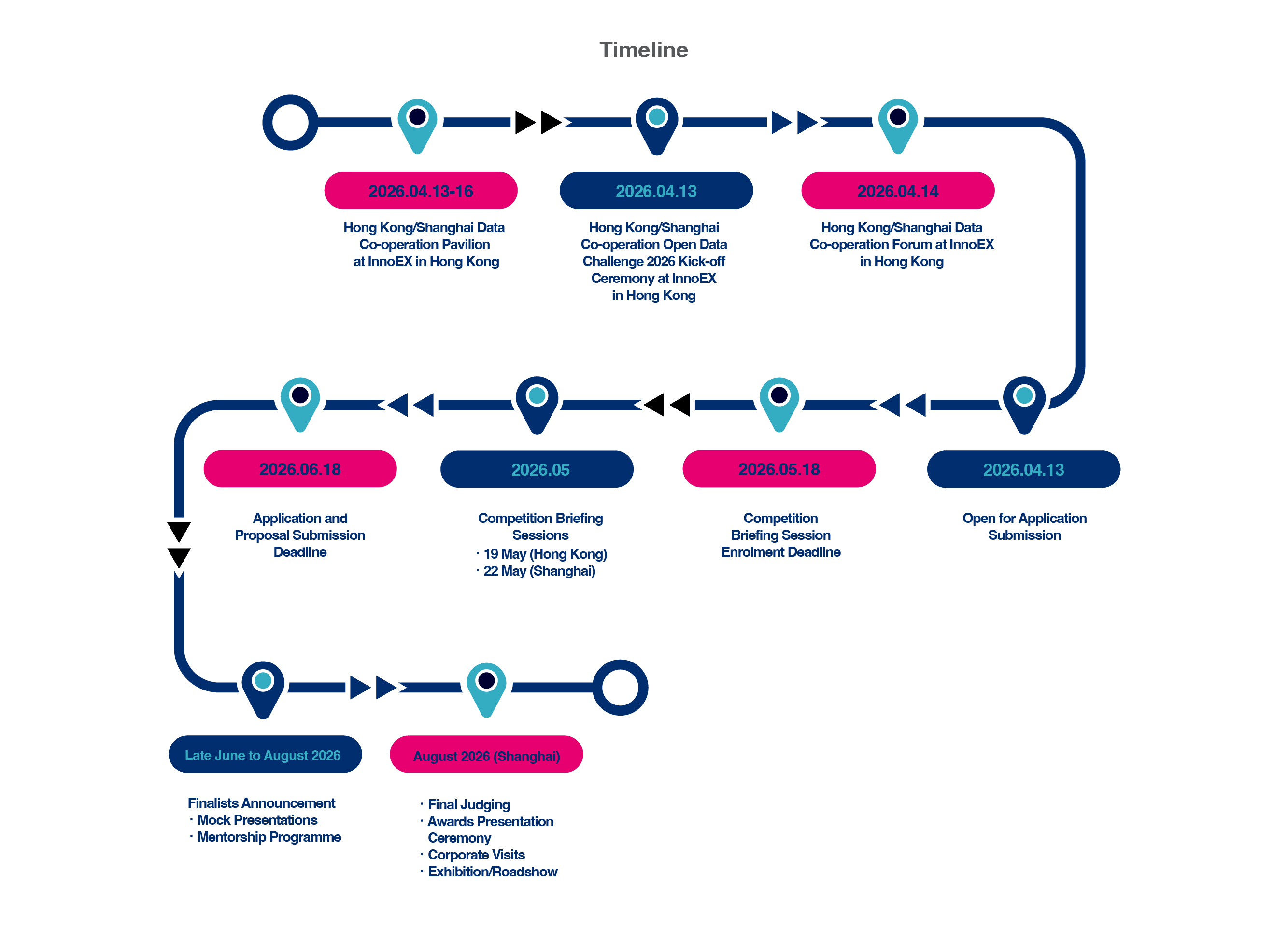
Timeline

Timeline

Eligibility

Eligibility
  • We welcome all talents in Hong Kong and the Mainland to share their open data-driven solutions with the use of algorithms and take the challenge at the final contest in August

  • Criteria of candidates: Participants must be 18 years of age or older and residents of either Hong Kong or the Mainland. Both individuals and corporate teams are welcome. Corporate entities must be legally registered in Hong Kong or the Mainland

  • The proposal must be a data-driven approach solution with the use of datasets provided or recommended by the organisers, or any other relevant and reliable source of data

  • All information submitted must be true and valid

Proposal Requirement

  1. Prepare a proposal in either bilingual format (English + Simplified Chinese) or Simplified Chinese only, clearly explaining how you use open data to address a challenge under one of the 4 themes: Smart Environment, Smart Mobility, Smart Living and Smart Economy and the 13 sub-categories.

    The proposal can be prepared using: PowerPoint Presentation, slideshow, document and/or other formats. However, the final file must be converted to PDF format before submission.

  2. Record a proposal introductory video of no more than 3 minutes in either English (with Simplified Chinese subtitles) or Putonghua.


Judging Criteria

Judging Criteria


First Judging


Innovation and Creativity (20%)

  • Innovation in addressing specific challenges or advance smart city development

  • Creative problem solving with a new form of application and effective data-driven solutions

  • Cost-effective implementation and integration of various resources (including list of datasets) or technologies

Functionality with Relevant Use of Open Datasets (20%)

  • Understanding and effectively addressing requirements of users (customers, citizens, stakeholders) per study of related data to solve the issue

  • Empowering users to accomplish their functions efficiently (customer-centric and citizen-centric)

  • Regulatory compliance and industry/sector best practices compliance (if applicable)

  • Ease of implementation

  • Providing scalability and interoperability;

  • Enhancement planning for foreseeable market / sector / community needs

Market Potential/Performance, Internal User Buy-In or Public Acceptance (20%)

  • Current market share/customer base and rolling take-up rate

  • Realistic/ justifiable projections for local market growth

  • Potential for diversification into new industries, sectors or communities

  • Potential for international market expansion

Benefits and Impact (20%)

  • Introduction of new operational models for commercial and public enterprises

  • The extent of new and enhanced revenue/profits and/or tangible cost savings, (monetary, efficiency and productivity)

  • Creating impact: industry-impact, sectoral-impact, social-impact on accessibility and availability, quality and satisfaction for customers/citizens

  • Enhancing public/market/sectoral community awareness of new services and benefits

  • Including environmental protection, social responsibility, and governance (ESG) factors in measuring sustainability and societal impact of this project

Technical Aspects (10%)

  • Employment of heuristic and computational data models and algorithms

  • Proven effectiveness of selected algorithms for improving efficiency and analyzing the data used for specific types of patterns and trends

  • REMARK: The algorithm applied would be tested as part of the solution evaluation

Quality (10%)

  • Reliability and stability

  • Quality standards as reflected by external quality marks/certificates; User-friendly interface (if applicable)

  • Good presentation with team work

Other Evaluation Considerations

  • Comprehensive understanding of the selected proposition

  • Clear explanation of data selection and usage

  • Analytical tools/ models with insights justification

  • Level of impact towards businesses and people’s livelihood

  • Team’s innovation and data utilization capabilities

  • Feasibility of transforming data works into data products (bonus points)

Final Judging

Problem Demand (10%)

  • Description of the motivation and ideation process, including pain point analysis, evaluation of existing solutions and their shortcomings, identification of target audiences, unmet user needs, or market opportunities. Discovery of new challenges is encouraged

Creativity and Innovation (20%)

  • Demonstration of unique creativity in aspects such as data integration, usage, application scenarios, and business models

  • Differentiation from mature industry solutions, showcasing certain technical innovations

Data Application (10%)

  • Clearly listing of datasets utilised, data analysis details, integrated data applications, and security measures

Technical Framework (10%)

  • Explanation of model concepts, modeling processes, algorithm innovation principles, and submitted technical solutions

Outcomes and Analysis (20%)

  • Detail the expected application outcomes and international applicability of the solution. Explanation of the application of algorithms, based on the algorithm model and the competition data, the output of the model analysis result set, evaluation scores, and the analysis of the application results

Project Value (20%)

  • Highlighting potential social benefits, economic returns, and commercial value of the project, emphasising the solution's unique value and highlights

Key Risk Issues (10%)

  • Identification of key market or technical challenges and proposal of a reasonable and feasible avoidance plan

Judging Process

Judging Process


Assessment Process

In the course of evaluation, the curator, B4B Limited, and the judging panel may require access to relevant information in the applicant’s possession. The Applicant will be notified in advance if such a need arises. All collected information will be treated with strict confidentiality and will not be disclosed without applicants’ consent.


Remarks

  • Applicants must comply with the relevant regulations and case practices regarding personal data privacy, data security, and data compliance in both regions

  • Applicants should be aware that offering incentives or inducements to curators, or engaging in any actions that may bias or influence competition outcomes, will violate relevant laws

  • In the event of any disputes, the organiser reserves the right to make final decision, which shall be binding on all relevant parties

Awards and Benefits

Awards and Benefits
  • Connect with industry experts to develop best practices

  • Gain knowledge about the open datasets in Hong Kong and Shanghai and explore real data-driven business opportunities

  • Promote open data development in both cities and deepen talent exchanges and co-operation

  • Receive training from open data providers to gain in-depth understanding of datasets in both cities

  • Understand the role of data prosumers and engage in the data ecosystem platforms in both cities